Monday, 28 February 2011

Evaluation

In what ways does your media product use, develop or challenge forms and conventions of real media products? 

Our media product is based on the research of other media products, their conventions and forms, which we included, developed and in some cases challenged, into our idea's we created for our Music Video and it's Ancillary products. Our brainstorming led to a development of our idea, but the research stage led us to eventually finalise certain aspects (forms and conventions) of the idea, according to what we discovered.

Our first plan of action was to find other media products that were similar to the idea we wanted to create, as well as the type of music we were designing the video for and analyse the aspects that they used. We looked through popular videos from such bands as Bloc Party, Temper Trap, The Maccabees, Mumford & Sons, Foals etc. and noticed conventions that we wanted to include and adapt in our own product. These were: Animation; Live shots; Lighting; and Triggers.

There are numerous places in which you can find examples of how we have followed conventions, using our research and exploration to establish an understanding of how to incorporate these conventions into our product.

We noticed that many bands of the folk/indie genre (which is the same genre of 'Belingo', George and my self’s band used in the video) who produced a promo video, or something of that sort, usually have music videos that primarily use animation as a main convention of their video. For example, this can be seen in certain videos of the bands we analysed, like Jet (Are you gonna be my girl?), The Maccabees (Precious time; Latchmere) and the Fray (Heartless) and a few others. This was a convention that the whole group believed would be perfect for our own product too. We chose 'Stop-motion animation', which is frame-by-frame photography, much like the animations seen in the many of the Maccabees videos, including the ones we explored. We found this to be appealing to us, as well as financially efficient for us and within our capability, since some members of the group did not much experience or had only explored the convention on a personal hobby level. After checking with our demographic, via means of a questionnaire, we decided 'for' the idea and our final product shows several scenes of stop-motion animation. 

Another important convention we discovered when investigating upcoming bands or even developed bands, when you look back to their beginning promo videos, the amount of time that the band members are visible in the video compared to later videos, where acknowledgement of 'who the band are' and 'what they look like' is not as necessary since they would have progressed in fame likely through the media. We found this to be case whilst researching many of the bands I’ve have already mentioned. However, we took a few cases further and analysed to show the progression of the bands videos. These include Bloc Party, who's videos ranged over various album releases, to Temper Trap, who were upcoming with videos from their first album. Both showed a healthy progression, which consisted of: The band being the main focus of the production, mostly what they look like and wear, in the first videos; In later videos showing the band often, but usually in a story driven video or a video with another convention (something we did later take into account); and the latest videos either not showing the band at all and using a different form or convention to interest the audience, or the band are featured in minimal amounts, by means of live shots or story driven once again. Since 'Belingo' are a local and undiscovered band, we thought it appropriate to follow this convention by showing the band as much as possible. 

Finally, one other convention that is clearly followed is the location used for the music video. Other such products, like Foals (Balloons) and Mumford & Sons (Little Lion Man) are situated in a small hall or small room of a house. This seems to be typical of the Folk/Indie Genre and a convention easily available to our group also. Discussions within the group led to the outcome of a Church Hall, which we felt with the right lighting, would be a perfect representation of that convention. From here on, we started to adapt and challenge conventions.

The conventions that our group used but challenged and adapted are found most prominent with our use of Lighting and Dynamics. Our own lighting effect used within the product differed to the lighting effects we analysed in the bands mentioned previously. We used household lighting to give a calm, warm feel to the hall we were using, much like the 'Little Lion Man' video by Mumford & Sons. However, we wanted to change the feel that the lighting gave in relation to the emotion and lyrics of the song. Once the breakdown of the song occurred, the lights would flash on and off. Bands like Temper Trap also used flashing lights in their video 'Fader'. However, in Temper Traps case, the lights flash throughout, and in other bands case, the lighting does not usually change very often. We wanted to bridge these ideas, as well as convey our own method of empathising the emotional stages of the song; Lighting was a key part of this. As a group, we thought this would be a effective way of gaining the audience’s attention to the song, as it may not be something that they are used to seeing. 

The dynamic of a video has also been challenged to the common structure we analysed in the other videos. We noticed that music videos often fall into a dynamic category, such as, a 'story driven video', an 'animated video' and a 'live video'. Looking through these different types of videos, we sought a way to make our video unique from the norm. Since most videos contain only one type of dynamic, we decided to create a hybrid. For example, The Maccabees videos present the audience with a completely animated experience, whereas, 'Fader' by Temper Trap show only live shots of the band. Since we had already early discussed from the results of research, we should include many shots of the band, but first videos usually fall under the animated category, we decided develop and challenge these two concepts by combining them in our video. It is difficult to find an example of a live shot and animation hybrid video in the folk/indie genre, but we believed a combination of both would suit our audience very well, since they enjoy the creativity of animation and the familiarisation with the members of the band. This left us we some of the common parts of music videos changed by our hand.

To conclude, we have used many conventions that are typical of the folk/indie genre from which we have followed, developed or challenged so that they suited our desires for the final product, whilst retaining a professional and recognisable similarity to the music product of the same category. The animation as a feature is common throughout music videos of this genre, which also adopted icons, such as, the 'Belingo' title, the heart pulled apart by hands, which they could relate to the genre or could be recognised by a previous viewer as well as live shots of band member, so their new audience can familiarise themselves with the faces. However, challenging conventions was also present by means of lighting and dynamics, where we bridged two common concepts that were typical of our analysed music videos. For example, the 'Live shot & Animation' music video hybrid, rather than the conventional singular feature music video.


How effective is the combination of your main product and ancillary texts?

We thought that the best way for us to combine both the main product and the ancillary texts was by using a 'running theme' throughout the productions, to insure that each piece complemented the other. The main features we included to insure this were: Animation, the colour scheme and font and the inclusion of the 'Belingo' logo on all three texts.

The Animation, being a key feature of our production, fitted well into all of the pieces. Since we used photography to create the Stop-Motion Animation, all of our original photos and items we used to create the animation were available to us, so we decided to use those pieces in our ancillary texts as well. Also, since some of the items were used in the video, if they were to be seen in a magazine advert, anyone who had seen the video are more likely to respond to the inclusion of those items. The creation of both ancillary tasks were produced using Adobe Photoshop CS3, where we edited, cut, pasted and tried to as much of the animation items into our magazine advert and CD/DVD cover. This is also where the colour scheme was introduced. From the discoloured white paper we had used to shoot the animation, we used Photoshop to gain that very same colour and included it in both ancillary texts, to further show the link between each element. A final and subtle feature was the use of the same font, Arial, on both pieces. We used various different methods to ensure the effective combination of all our productions so that the audience could easily distinguish that they are from the same band.

What have you learned from your audience feedback? 

From audience feedback that we received throughout the production of all three productions, I have learned that audience feedback it critical, especially as certain stages of the production. For example, My group and I altered our storyboard according to the response we gained from a possible audience. This was only during the construction stages, when we had not finalised our storyboard, but nevertheless, it was crucial to the eventually finished product. It allowed us to see unnecessary areas of our first drafts and establish key points of the video we wanted to highlight (e.g. Whole band shot at the beginning, rather than an introduction of each member slowly). Overall, the audience allowed us to create a better product for our audience, and taught myself and our group the importance it has on a product.

The feedback we received once the product was in post-production and eventually finished was relatively positive. However, it also taught me and my group the importance of lighting, especially since we used that convention as a key part of our video. One comment read, 'in some cases the lighting was very dark and hard to see band members in the corner.' This constructive criticism was very helpful for me and my group seeing as it was related to a key feature we wanted to include, which was the creative use of lighting and the ability to see each band member. Unfortunately, that viewer clearly had trouble due to our lighting choice, and the chance for him to familiarise with the band members is then stunted. However, 'I like the animation' was a comment we received, which showed the successful implementation of animation into our live shot/animation dynamic, which was something our audience may not have seen before. I have learnt the importance of the audience feedback in the early stages of any production can lead to a product that appeals the demographic it is aiming for, which i believe my group achieved.

How did you use new media technologies in the construction and research, planning and evaluation stages? 

During the production of all of our media texts and main product, we used new media technologies to help us through. During the construction stages, we used Windows Movie Maker which was used to piece together our movie, enabled us to edit the sections we deemed unnecessary and include any special effects or additional features we thought that the video would benefit from, and our audience would enjoy. Moreover, it allowed us to follow our storyboard by placing certain shots in the correct places. There was one case we found where we had a few shots that a tripod was visible in the background, so we used the program to replace them with other shots. It also allowed us to combine the music and shots which we had to manually sync in order for the production to look professional and correct. We used a Flip Ultra HD Camcorder for the shooting, and a Nikon Coolpix for the photography of our animation, seeing as the camcorder was no stable enough on tripod to prevent too much movement. Furthermore, the Nikon was a far fastest method, which enabled us to construct the animation section much quicker

In terms of research and planning, we incorporated new technologies in various different ways, one of which is the blog I am recording on now, Blogger. It has allowed us to keep a dated recorded of everything we have needed to mention throughout the course. Its ability for people to comment on posts gave us another direction for people to respond, given us more audience feedback to work from. It's other media-related capabilities, such as embedding videos, pictures and dated posts gives us a much faster and easier access to the information we need show, rather than a viewer having to follow links and discover it for themselves. Microsoft Outlook was used by each member of our group so that we could keep organised by keeping each other informed of what we needed next in the production or what we needed to bring etc.
Microsoft Excel gave us the opportunity to present our results of our questionnaire in a clear and concise manner, whilst recording the detailed information. This made the analysis of those results much easier due its user friendliness. Windows Movie Maker helped us to practice with the type of animation we were intending to use (stop-motion animation). It also gave us an insight into the program so that when we used it during the construction process, we were not beginners to the software. This is how the new media technologies have helped in there various different ways.

Our blogs feature all of the information I have needed to write the evaluation, showing that Blogger, for any viewer to this blog, could easier search for the information I have mention and find it with little hassle. This new media technology has helped to simplify this process. Youtube proved to be an invaluable media technology for us throughout the whole project, especially the research stages. However, during the evaluation, it meant we could upload our video and link it to people, meaning we could gather as much audience feedback as possible, since Youtube is a global website. This new media technology has helped us gather that invaluable information from our audience via a quick and easier link. Facebook as new media technology should also be mention since it was used to link the video to friends, in the form of social networking.

To conclude, My group and I have used various types of new media technology during the these four stages of Construction, Research, Planning and Evaluation. Such programs as Windows Movie Maker, Youtube and Blogger have proved themselves to be invaluable tools and provided us with ability to successfully follow all four of those main stages. Youtube, Facebook and Blogger have also allowed us to record all of our information, as well as share our video with our audience with a short link, making their respond much easier for us to get hold of. Our use of different cameras, Microsoft Excel and Outlook has also enabled us to improve our production to a higher standard.

Wednesday, 2 February 2011

Ancillary Task: Completed CD/DVD Case

This is the completed DVD/CD cover for the promo video 'Lonely Hearts' by Belingo. It follows the same theme as the magazine advert and the animation included in the video, whilst also using some of the items used within the animation too. The font and colour scheme are all the same to insure that all of them media texts look like they belong together in a package.


Ancillary Task: Completed Magazine Advert

This is the completed magazine advert for the 'Lonely Hearts' promo video. Much like the other magazine adverts we research, this one includes similar features. As well as following the running theme, that can be found throughout each of our media texts, we also included the same font and colour scheme. In the bottom right corner of the advert, there is a caption of the front of the CD/DVD cover. This caption feature is found on most magazine adverts, especially ones that advertise a tour that represents the album release. We saw it necessary to include it.


Monday, 24 January 2011

Ancillary Task: Magazine Advert Design

After the initial research we did on magazine adverts, we created a design for our own magazine advert. We choose that to follow the colour theme featured in the animation of our production, a discoloured white. We will also include some of the images we used to create the animations. For instance, the dove and the split heart. We did this because the band adverts we had researched, most notably with Arcade Fire and Bullet For My Valentine, who followed their theme throughout, of there CD covers, magazine adverts and music videos. This is why we have tried to implement similar themes, such as colour scheme, into our own advert. This will allow it to become more identifible as a product, hopefully allowing it to be recognised by a wider audience, maybe even outside of our demographic. The Maccabees are also notable for using images from the CD covers etc and including it in their animation.


Wednesday, 19 January 2011

The music video

Main task: Alterations

During the post production of our music video, we had to make some alterations to insure that we kept the highest degree of professionalism, as well as avoiding amateur mistakes and continuity. Here are the changes we made to our original ideas, which can be found on the video planner and storyboard in earlier posts:
(All pieces in Red are the shots we decided to use instead)

0:14 - 0:17: Originally, this was meant to be a mid-shot of the singer. However, as we are trying to introduce the band to our audience, we opted to use a close-up shot of the singer instead. This way, our audience will be able to see his face as if they were next to him, rather from a distance. Since he is the front man of the band, he usually is key to recognizing who the band are, so this is very important that we capture this for our audience to see.


1:12 - 1:14 and 1:34 - 1:36: During these times, we were intended to have a long shot of the guitar playing his parts. However, once we reached the post-production/editing stage, we noticed the long-shots we filmed of the lead guitarist showed the tripod we had used in the background. Of course, we could not include these shots, otherwise we would be negative to our video, since it shows amateur mistake, continuity and degrades the professionalism of the piece. It is very unlikely for you to find these sort of mistakes in a professional music video. To right this wrong, we had to use a Two shot of the lead guitarist and bassist that we had filmed and used in another section of the video. Since we did not have the time to re-shoot this section, we had to use another shot. We tried not to use the exact same two shot, by cutting an earlier or later part of that full two-shot. With this change, we are saving ourselves from affecting the professionalism of the video unintentionally.


3:21 - 3:23 and 3:29 - 3:31: In these shots, we aimed to get low-angle mid-long shot of the lead guitarist and the same for the bassist. However, again in the post production stage, the lighting of those two clips were far from acceptable. We didn't notice this when we were shooting the shots, so we didn't make adjustments. Instead, we've decided to use a low-angle two shot of both the lead guitarist and bassist which we also had, but hadn't used until then. The lighting on these shots we sufficient, and a much better improvement to the other shots.

Monday, 6 December 2010

Problem with, (and solution to) the music video

We have been informed by a band member that his job restricts him to certain times for us to shoot the music video. His job spreads from Monday to Friday so our original plan to shoot the video on a Thursday or Friday during the day has had to be altered. We search for other options and have now planned to shoot the video in the Sandgate Church Hall, where as a band we usually practice. It is not too far from the school stage we were originally planning to use, so our location look, based on our research should not differ too much.

Another problem we have found that due to Matt's work constraints, he is unable to film the section where he catches his drumstick before activating the whiteboard to show the animation. Instead, Aiden will take the place of not only Matt, but all the other members role's in relation to the whiteboard 'activation'. This way we will not have the time constraints of all five members. However, this will not alter the band members unique action during the video. For instance, Matt will still throw his drumstick off shot (this will be filmed at Sandgate with the rest of the video), but instead of himself catching the drumstick, Aiden will be there instead.

UPDATE: We again have decided to alter the video. Aiden will no longer feature in the video, but instead we are going back to the original idea, with a few slight differences. We saw it unnecessary for someone to catch the items to 'activate' the animation, so we have decided to show the unique items landing on a white background, most likely a large piece of card around A1 size, and be the starting point of the animation. From that background, we can use the same background to film the animation so it does not look uneven.  

Wednesday, 1 December 2010

Ancillary Tasks - CD/DVD & Magazine Research

Due to the weather conditions, we were unable to begin with the intial filming as George was not able to get into school. We saw this opportunity to make a start on some ancillary task, beginning with the research. We searched the internet for magazine adverts but had no luck, so we took the other option of actually purchasing a few magazines to find the adverts. We got two popular music magazines, known as, Kerrang! and NME. We managed to find a few useful adverts in these magazines that we could anaylse and depict the type of features, structure and themes we might want to include in our own magazine advert. Even though the bands featured may be of different musical genres, we can still use the adverts for ideas.

Bullet For My Valentine - The Fever Tour
(Found in Kerrang! Music Magazine)


On the left, there is an advert for Bullet For My Valentine's latest tour 'The Fever Tour', named after their latest album 'The Fever', featured in the centre. Straight away, there is an unmissable feature in the background of the advert. It clearly displays the same image as featured on the album cover of a semi-nude woman. This seems an obvious feature to include on a magazine advert, as it will inform of the audience of what album they will expect to hear if they attend one of the dates of the tour.

The image on the right hand side is the band's first album, 'The Poison' which follows a very similar theme of gothic, curved, sharp text; few but effective colours and another semi-nude woman. The gothic-like text is seen as fairly normal for bands of a hard rock or hardcore genre. There is a strong link between both albums, the theme and the magazine.

In terms of colours, both ablums use a little amount of standard colour. 'The Fever' has a blue colour to it whereas, 'The Poison' has a red colour to it. They also seems to be slightly faded or greyed over, with a grain effect over the top, again to give a gothic feel to the band, likely to appeal to the band's fans.

The magazine advert is full of the necessary information for anyone to find out about the band's new tour. This includes: the name of the tour; some of the dates and locations of the shows, with numbers to ring; the website of the band; and a caption of the album in the bottom left corner. The text follows the same colour themes as the album, but includes a 'red' for the dates of the tour. this could be used as a focal point for fans looking for the location of their next show.

Both of these products, the magazine advert and the related album follow the running gothic theme that the band aim's to represent and appeal to

Wednesday, 24 November 2010

Shooting Schedule

From the video planner, we have now been able to create a shooting schedule, which means we can plan and insure we will have all the props and order of which scenes we need to do is clearly presented to each of us. Therefore, there will hopefully be no complications when we decide to shoot the video. (By 'page' on the shooting schedule, we mean a A1 sheet of card we will use to form a background whilst we take photos.).
Here is the shooting schedule:

Video Planner

This is the video planner. These images show how we plan to shoot the video. Now that our storyboard is complete, we can concentrate on this aspect of the preparations:


Monday, 22 November 2010

Audience feedback to storyboard update

We recieved some audience feedback from our initial storyboard ideas. We took this into account seeing as our audience need to be happy with our production for them to rate it highly. A comment which read 'The shots before the song plays seem unnecessary,' raised a point that we took into account, since it was discussed amongst the group too, where we removed 30 seconds of none music based video before the music began. The final storyboard presents these changes with the shots at the beginning of the song. Instead, we chose to show the guitar playing the beginning guitar part to give it a quick snap to action, hopefully to interest our audience from the very beginning. Another piece of audience feedback caused us to decided to change the sweeping shots between each member and instead, change it to straight cuts to keep the audience in that quick snap of action, and instead utilise the other shots and transitions later in the video. For instance, tracking shots of the drums at 1:24-1:28

Here is the final version of the storyboard:


Wednesday, 17 November 2010

Storyboard updated

Here is the latest version of the storyboard:


The changes we have made were mentioned in the last post we posted involving the first draft of the storyboard. We decided to make it short and sweet with a sweeping shot of all the band members, whilst the music starts. Therefore, the introduction of each band member is still included as an integral part, but not dragging out unnecessary time. This hopefully will be more effective for our audience. At the start with an establishing shot, silhouettes of the band will be present until the start of the lyrics at 0:14 seconds. Later in video, when we decided to implement the animation, the drummer will throw a drumstick out of shot, where we would cut to a whiteboard with another person who then catches that drumstick to activate the animation section. This is the current stage we are at with storyboard so far.

Wednesday, 10 November 2010

Animation Experiment (unfinished)

Since we are considering implementing animation into our music video along with live shots, we saw it important to see what the type of animation we would be using (stop-motion animation) would look like in a basic form. The quality of the video isn't very good, but this due to the phone camera we were using, where as we would probably be using a high quality camera in the real product. This is only a test so the animation bares no relevance to our actual product.

Storyboard Idea

As a group, we have been thinking of a few ideas, which we decided to move into the style of a storyboard. This is an image of that storyboard so far.


The ideas shown in the picture we did decide to change, so another image will be posted later on. We are not changing too much from this idea, however, the initial 30 seconds of the each band member getting hold of their instrument we believe could be an extended 30 seconds before the video actually starts that is very unnecessary. It may prove to be tedious rather than a interesting beginning. Each band member instead will start with their instruments in hand, playing along with the music. We believe this to be easier to watch for our demographic, especially for possible new viewers who have never heard of the band, they are more likely to want to get straight into the music.

Monday, 8 November 2010

'Lonely Hearts' - Belingo

We have come to a final decision to use 'Lonely Hearts' by Belingo, (George and Myself's band) as the recording to use for our music video. We believe the recording quality is far better over the other option of 'Let Us Be Known'. Moreover, we find that 'Lonely Hearts' is far easier to generate and create theme for the video, for instance, following a theme of a heart break in reference to the title. As we feel that animation will be best suited for our video, we believe that this song would be the most appropriate for that technique, as well as any others we decide to use along the way.

Wednesday, 3 November 2010

Main Product Planning - Flowchart of Stages

The brainstorm sheet has allowed us to gather our ideas, and we have now processed them into a flowchart, which we can now use as a guideline for our production tasks.


Update: Aiden noticed that the storyboard was not mention in the flowchart. We decided it will be the next stage after choosing the song and features that it will include.

Main Product Planning - Brainstorming of Ideas

After researching various different forms of audience and product details and information, we began to start planning the main product of our A2 production. Here is an image of our brainstorm sheet:


Monday, 18 October 2010

Belingo - The band for the video


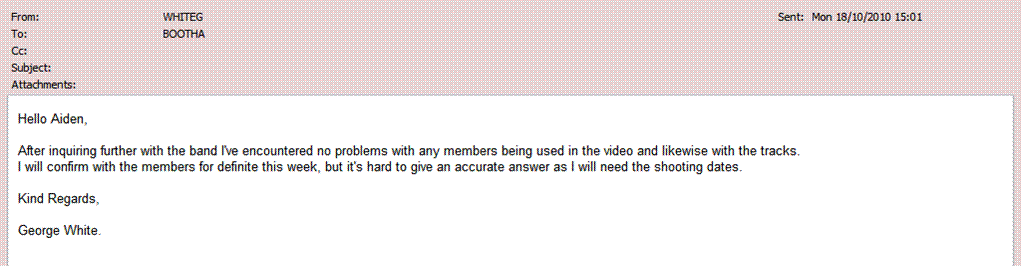
Belingo, the band George and myself happen to be a part of, are the most suitable band for us to use for our A2 production. As we have a recording of the song we wish to use and own the rights to it, we will avoid any issues or problems we may have had trying to find another band, song or performer due to permissions and licenses. The music is original, therefore, it follows the brief. Initially, when George and myself asked the three other members of the band about their thoughts of doing it, they were happy to help out. We spoke with them again recently to confirm this and it was okayed. George sent an e-mail to Aiden informing him.

(Click to view an enlarged image)


Things are going according to plan so far with the band willing to participate.

Wednesday, 13 October 2010

Questionaire - Graph Results


After recieving a fair amount of data from our questionaire, we have collaborated our entries together to gain an understanding of what the audience would like to see in a music video. This post shows the graphs of results, the anaylsis that follows and our decision whether or not to use the audience feedback provided for our video.


The graph displays the results of the age of the participants. The majority of them chose between the ages 16-19. This provides us with the information that this age group are the most important to us when creating the video, and have to keep them in mind as a top priority, as they are more likely to be the judges of our production package. Aiden found some secondary research that supports our graph's results. The research found that the age bracket 12-19 on average spend £37.55. (Found from http://www.theregister.co.uk/). Our graph results, and the secondary research suggest that our demographic is going to consist mostly of this age bracket.


 Evidently, the graph above shows the results of the gender of the participants, which are clearly shifted to being mostly male. There are a few females however which will hopefully keep a reasonable balance.


The results of our graph put the majority of the participant in the region of £41+, with an almost equal amount from £11 - £20 & £21 - £40 collectively. This is likely due to digital download and access to music videos. No one in the questionaire selected £0 - £5. If we were to sell this single, we would have to give the best quality that we could do to insure that we would satisfy our demographic.

Over half of our participants agree that music is more accessible when it is accompanied with a supplementary video. Obviously, we cannot ignore the section of people who choose 'no preference', showing that the music video is not important to them, in terms of accessing music. But, to please the majority, we will need to make our video to the best quality that we can.


Like the previous, this graph has the majority in the categories 'yes' and 'no preference'. This gives us evidence that people would more likely prefer to have a video that accompanies the music, as it would help them feel more involved with the music, as the question suggests. The minority that answered 'No' lets us know that music videos are not always considered necessary to be part of the music. This may be from a selection of people who do not usually listen to music with a music video, or music that has no music video (e.g. On the radio). Although, according to our graph results, it is more likely for our following to buy the music along with the video.
This graph shows that people usually watch videos fairly frequent during a week, in some cases, daily. Although the previous graph showed that people do not find music more accessible with it's music video, this graph helps to prove how useful music videos are in the distribution of music and its accessibility. It is important that we create the best possible video for the best possible results.


From this graph we discovered that 84% of people that completed this questionaire use the internet or the TV to watch music videos. For us, the internet would be the only realistic option, seeing as gaining access to TV music video can be highly expensive and far to complicated for time we have left. However, the internet is by far a sufficient enough medium for our group to distribute our video to our demographic. It has proved to be successful for other musicians.


This graphs displays the participants response to their favourite types of genre. The results favour Rock & Indie, but do display a fair amount for all of the others. Belingo, being of the folk/indie genre, generally fits quite well with these results. As our group also like folk, indie and rock music, it will be enjoyable to try to create a video based on these genres.


This graph presents us with almost equal results. 43% prefer it when a band is directly invovled with a music video, leaving a large percentage who did not mind whether the band were directly involved with the video. Therefore, we are considering implenting roles for each of the band members, seeing as our demographic find it a popular convention.


Animation is a feature our group all like in a music video, and as the results show, so do the majority of the participants. It is also a lot easier to implentment than other categories, such as, special effects and fantasy. Realism is another feature that is popular in the results, we could try and use this in conjunction with the animation, to maximise our production to how our demographic would enjoy it.

According to these results, it appears that the participants prefer the music to have some sort of story line intergrated into the music video. Story lines are a common theme, along with animation. 42% however, have said they have no preference or prefer it when a video does not contain a video. So it is up to our group to decide whether we think it is necessary or not. Looking at the previous graphs, I think we prefer the idea of animation and/or realism as a feature.

The questions we added at the end that required the participant to write an answer opposed to multiple choice. This meant we could not create accurate graphs for the wide range of response we got from the wriiten answers. However, we analysed them here:

What is your favourite music, and which feature(s) of it appeals to you?

After sifting through the different answers we got to these questions, two videos stuck out clearly and popular. The videos were 'Here It Goes Again' by OK GO, a popular music video involving stylised movements on treadmills which became hugely popular on Youtube, and the other 'Feel Good Inc' by Gorillaz, which Gorillaz are well known for the animation based videos and characters, which this video also provides. The reasons these were popular were because of the creativity and originality, and the quality of animation. Animation being our group personal favourite, we are considering it a lot. 

The questions based of the representation of male and female overall gave a general 'no preference'. This gives us freedom to representation both genders as we wish. However, we will aim to display both genders as close to how typical media texts of this genre do, to help draw in our demographic, of both sexes.

Monday, 4 October 2010

Product Research: Forms and Conventions - Progessions of Band Music Videos

Our group and I have furthered our research of forms and convention, specifically into the progression of music videos that bands produce. Undoubtly almost all signed bands have more than one music video, and these music videos can show the progression of the band into the fame and recognition by the public. We can see this by the type of video, inclusion of special effects and band members visable in them. For instance, an example we researched, that I will go into further detail on is the band, Bloc Party. The progression of their videos start with the band members visable, so the viewers can fimilarise themselves with the band. The videos then gradually change, from the band being seen, to animated, to not in them at all. This is just one example of bands that, with the increase of fame, start to choose different forms and conventions, such as, actors, storylines, computer generated material, possibly even world events or other videos. Here are some examples:

BLOC PARTY

Silent Alarm - (First album)

So Here We Are - There are various close ups of the band. This allows us to familiarise ourselves with the band
.


Pioneers - Features members of the band in animated form, similar to the music videos by Gorillaz. It is possible that Bloc Party maybe trying to recreate the success of Gorillaz’ videos; since they’ve won 11 major awards since they were established in 1998, and been nominated for a further 24.


Weekend in the City - (Second Album)

The Prayer  - The first song released from their second album, features several other actors in the music video, though still revolving around the band members.


Hunting for Witches - This contains shots of the band only, in a dark area.


Intimacy - (Third & Latest Album)

Flux - One of the bonus tracks on the album. This video does not feature the band, and instead, displays robots causing chaos in cities. With the band fully established at this point, having been nominated for several awards, and winning the PLUG Indie Rock Album of the Year in 2006, they no longer need to play a role in the video as their fan base has been established, and are aware of who the members are.


THE TEMPER TRAP

Conditions - (First & Latest Album)

Sweet Disposition - Being their first single, Temper Trap have used computer generated images with at one stage or another, included the faces of each band member, allowing the viewers to see what the band look like, as at the early stages of their career, it will be unlikely for them to be recognised.


Fader - The video includes the band once again present, insuring that the audience can still familiarise themselves with the band. They are in dark setting with bars of light pulsing and flashing on and off.


Love Lost - The band do not appear in this video, an example of there growing success and their ability to be recognised by their audience. The initial success of their first two singles (Sweet Disposition won Drum Media Writers’ Poll’s ‘Single of the Year’, as well as Time Off Writers’ Poll’s ‘Single of the Year’, and also APRA Music Awards’ ‘Single of the Year’) allowed them to explore and experiment with different types of vidoes and techniques. 'Love lost', their third single, contains a story motivated video of young boys running for their P.E. lesson in a country area. Actors lip sync the song and perform actions. These conventions can be seen in many music videos, such as  Bombay Bicycle Club’s video for “Evening/Morning” and The Drums song “Let’s Go Surfing”.